Tag Archives: Spirits Of India

December 2025 Issue

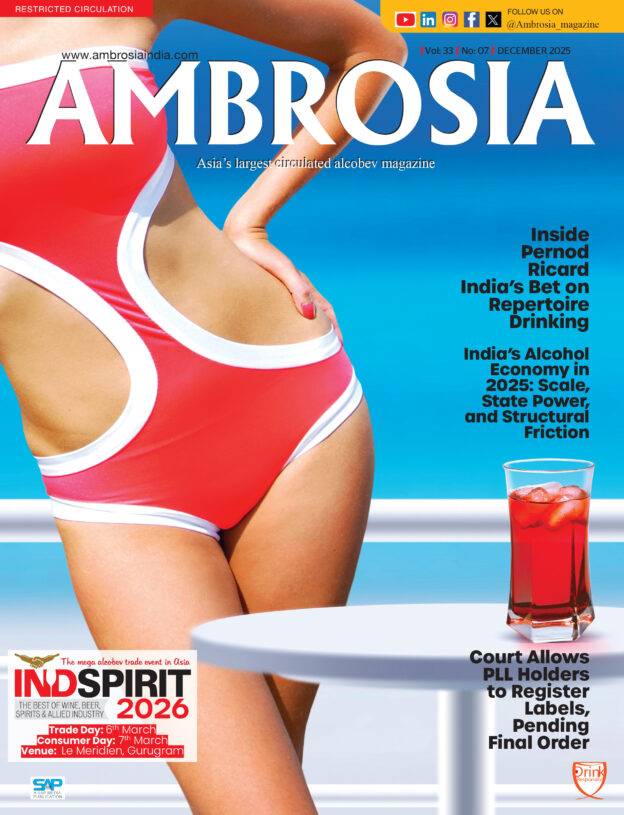
The December 2025 issue of Ambrosia is now live! (Click here)

The December 2025 issue of Ambrosia Magazine is here!

It features engaging and insightful articles such as:

• INDSPIRIT 2026
• What to expect in 2026
• Updates on the MML vs ISWAI case
• Pernod Ricard: India’s bet on repertoire drinking
• India’s alcohol economy in 2025: Scale, state power, and structural friction
• Court allows PLL holders to register labels, pending final order
• Exclusive interviews with Pernod Ricard and Bacardi, and many more

As 2026 Beckons: Reading the Signals of a Changing Alcobev India

INDSPIRIT 2026 and Tunes & Tonic Announced

If the final month of this year is anything to go by, 2026 promises to arrive with more than just optimism — it comes with momentum. The year gone by has been anything but quiet for India’s alcobev industry. From the Maharashtra government’s face-off with ISWAI to intense conversations around state control, taxation, and regulatory balance, 2025 has underlined how scale, state power, and structural friction continue to define this business. Yet, amid these challenges, the industry has also demonstrated resilience, adaptability, and an unmistakable appetite for growth.

Throughout the year, Ambrosia has stayed at the forefront of these developments — tracking policy shifts, decoding consumer behaviour, and spotlighting growth stories that make India’s alcobev landscape one of the most dynamic in the world. It is an industry shaped as much by regulation as it is by aspiration, and one that continues to evolve at a pace few global markets can match.

And speaking of consumer behaviour, 2026 will also mark the 21st edition of INDSPIRIT 2026, alongside the debut of Tunes & Tonic, a new consumer-facing experience set to take place in Gurugram on 6–7 March 2026. Together, these events promise to be bigger, bolder, and more immersive — celebrating the industry’s achievements while creating an energetic, music-led atmosphere that resonates with today’s experience-driven consumer.

In this issue, we continue that focus. Our editorial lens turns firmly toward the year ahead, unpacking insights that help decode where the Indian consumer is headed in 2026. From changing drinking occasions and premiumisation to the growing influence of moderation, mixers, and experience-led consumption, these stories are designed to help brands, distributors, and industry stakeholders plan better — whether that means sharper portfolios, smarter strategies, or more meaningful consumer engagement.

For those looking to understand the year that was, our feature India’s Alcohol Economy in 2025 offers a comprehensive snapshot of the forces that shaped consumption, regulation, and market sentiment. Built on perspectives from industry leaders, the article captures both the pressures and possibilities that defined the past year.

Equally compelling are our conversations with Jean Touboul, CEO of Pernod Ricard India, and Inderjit Singh Dhingra of Bacardi. Their insights shed light on how consumer preferences are shifting, how brands are responding, and what trends are likely to shape portfolios and conversations in the year ahead.

As the industry steps into a new year, one thing is clear — 2026 will reward those who listen closely to the market, adapt swiftly to change, and remain committed to quality and relevance. The challenges are real, but so are the opportunities. At Ambrosia, our endeavour remains unchanged: to inform, to question, and to provide clarity in a fast-evolving landscape. As the next chapter unfolds, we look forward to chronicling an industry that continues to redefine itself — one decision, one policy, and one drink at a time.

From Bar Counter to Global Stage

Great drinks aren’t made by accident. They take skill, patience, and someone who knows exactly what they’re doing. Akhilesh Sheoran is one of those people. Whether it’s crafting a cocktail that wins championships or introducing whisky lovers to some of the finest spirits, he knows his way around a bar… and a bottle.

His journey started behind the counter, shaking and stirring his way through some of the toughest global competitions. Now, as Brand Ambassador – Craft Spirits at Diageo India, he’s the face behind some of the most talked-about labels, including Godawan Single Malt, crowned the Best Single Malt in the World (2024), and United’s Epitome Reserve.

In this chat, he spills stories from his career, shares tips on spotting a great bottle, and even talks about disastrous food pairings. Whether you’re a whisky enthusiast or someone who just wants to sound smarter at the bar, there’s plenty to take away from this conversation.

From mixology to brand ambassadorship, your journey has been remarkable. What inspired you to enter the world of craft spirits, and how has your path evolved over the years?

Working with different styles of spirits and engaging with consumers, I realised there’s so much that goes into bringing these incredible spirits to the bar. This curiosity led me to explore the other side of the industry as a Brand Ambassador, a dynamic and challenging role that allows me to bridge the gap between brands and consumers.

Which of your victories holds the most significance for you and why?

All competitions hold their own importance, as any win comes with new insights and a responsibility to push the boundaries further. However, Diageo World Class India stands out as one of the most demanding and rewarding experiences. Its rigorous structure truly tests creativity, technical skill, and adaptability, making it an unforgettable milestone.

The alco-bev space is constantly evolving. What are some of the biggest changes you’ve seen in the industry over the last decade, especially in India?

India’s drinking culture is evolving, driven by a younger, growing middle class that’s showing a stronger preference for premium homegrown brands. More people are exploring craft spirits and beers, and embracing new flavours and experiences. This move highlights a greater appreciation for quality, creativity, and the narratives behind bottles, shaping a more sophisticated and adventurous approach to what we drink.

What makes a spirit truly “craft,” and how do you see India’s role in this global movement?

Craft spirits are defined by their small-batch production, emphasis on high-quality ingredients, and hands-on distillation techniques that prioritise authenticity over mass production. Craft producers often experiment with distinctive botanicals, innovative ageing techniques, and transparent but unique production methods. More than just a process, craft spirits are about the people, leaders who challenge conventional rules. India’s role in the global craft movement is growing rapidly, with a surge in homegrown distilleries that merge heritage with modern innovation.

With whisky gaining a younger audience in India, how do you see the preferences of Indian consumers evolving when it comes to single malts and premium spirits?

Over the past decade, Indian consumers, especially younger consumers have developed a refined taste for single malts and premium spirits. This shift is driven by rising affluence, global exposure, and a desire for more authentic, high-quality drinking experiences. What’s even more exciting is the growing appreciation for domestically produced single malts, which are now competing on the world stage, reflecting a sense of national pride and recognition of India’s craftsmanship.

What’s the best way to appreciate and savour a good single malt?

The best way is to explore different styles from various regions and find what suits your palate. However, the right technique makes all the difference.

Use a Glencairn or tulip-shaped glass to concentrate aromas.

Observe the whisky’s colour.

Nose the whisky gently, keeping your mouth slightly open to catch nuanced aromas like vanilla, spice, fruit, or smoke.

Take a small sip and let it coat your tongue, identifying layers of flavour; sweetness, spice, peat.

The finish, or how long the flavours linger, tells you a lot about its depth and complexity.

Adding a few drops of water can open up hidden notes, making the whisky more approachable.

Ultimately, whisky should be enjoyed slowly, in a relaxed setting, where each sip reveals something new.

There’s a growing curiosity about how to identify a high-quality whisky. What are the key characteristics one should look for while selecting a bottle?

For me, specifics matter; from the packaging to the liquid inside.

But key factors to consider include: cask type and ageing process (although older doesn’t always mean better), alcohol by volume (ABV), and distillery and production methods. Look for anything that talks about tasting notes and flavour profile, brand philosophy and heritage behind the whisky. A well-crafted whisky tells a story before you even take the first sip.

Amrut Distilleries launches ‘The Expedition’

Most expensive Indian single malt whisky, priced over ₹10.5 lakh

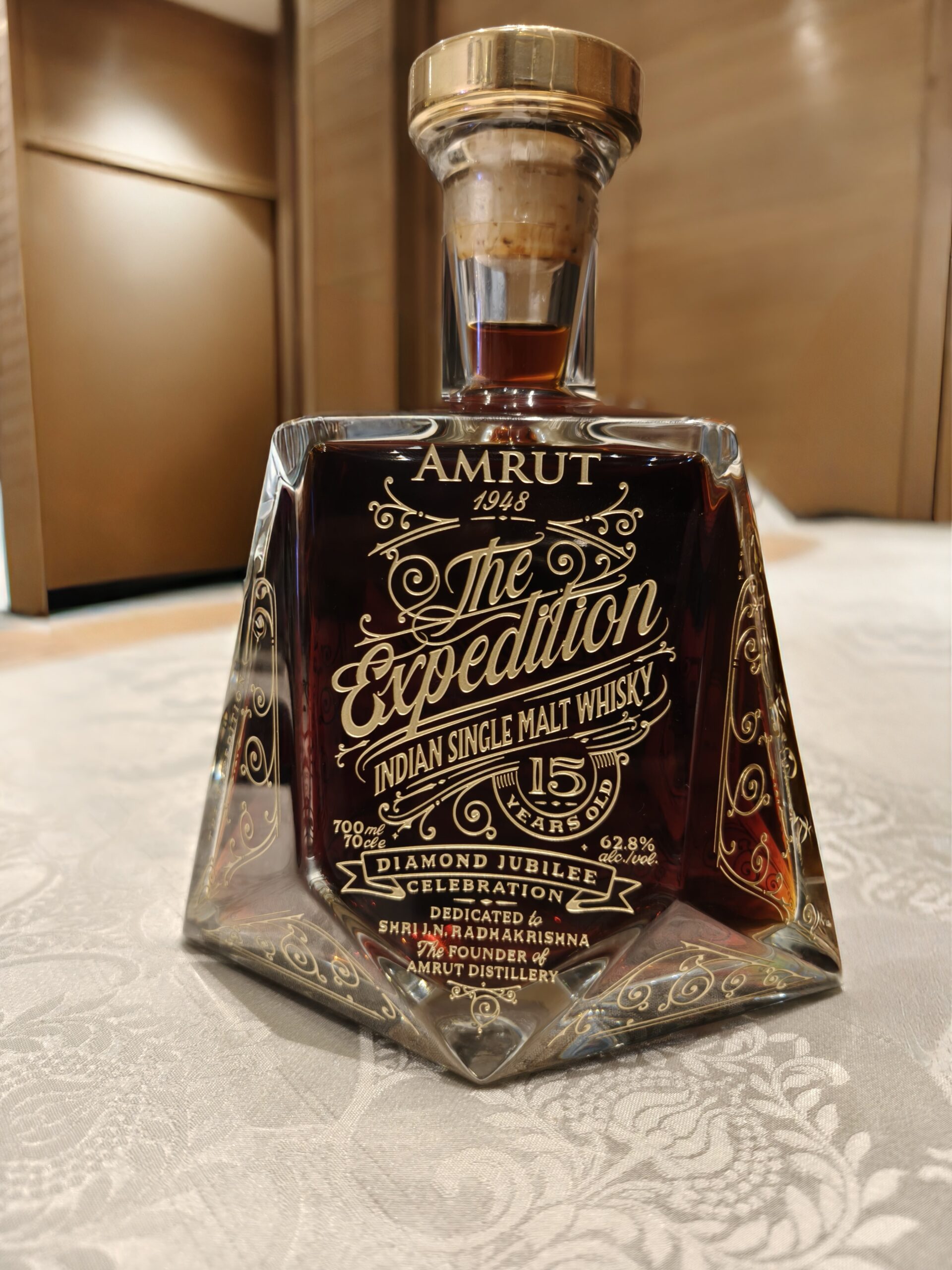
Celebrating its 75th anniversary, Bengaluru-based Amrut Distilleries launched The Expedition, its oldest single malt whisky, aged 15 years to the world market. To commemorate the occasion, it has released 75 bottles of the limited edition, each priced over ₹10.5 lakhs ($12,000).

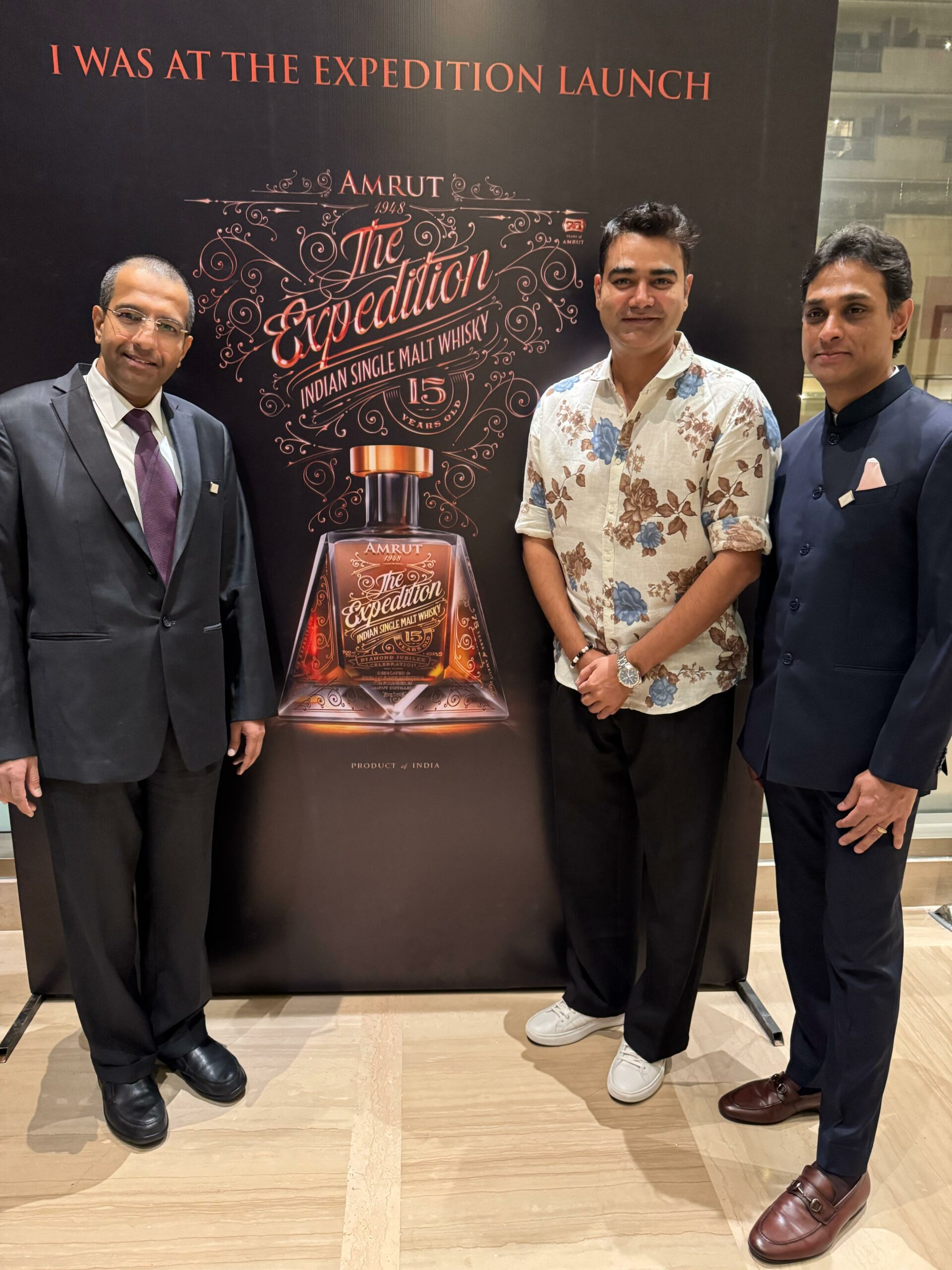
Ambrosia was invited for the special launch event where both the bottle and the spirit perfectly captured the essence of the celebration. The Managing Director of Amrut Distilleries, Rakshit Jagdale said that of the 75 bottles, nine would be for the Indian market and the rest going to the US, Europe and other markets. Two of the bottles have been pre-booked.

(L-R): Rakshit N Jagdale, MD, Amrut Distilleries with Bhavya Desai, Group Head & CEO, SAP MEDIA WORLDWIDE LTD and Thrivikram G Nikam, Jt. Managing Director, Amrut Distilleries

Amrut believes that The Expedition will elevate the entire luxury segment, demonstrating yet again the brand’s ability to craft exceptional malts beyond its regular range and setting new benchmarks. Amrut has been at the top of the game of Indian Single Malts, even as India’s premiumisation drive continues to motivate manufacturers to do better.

The Expedition has been matured for 15 years, the first eight years in sherry casks from Europe and then the next seven years in ex-bourbon casks from the United States, thus elevating its complexity and depth. The 15-year maturation period is a milestone in the Indian alcobev sector.