
Tag Archives: Indian Liquor Industry

Section 49 of Maharashtra Prohibition Act Invoked, Questions Locus Standi of ISWAI

• Government defends ‘Maharashtra Made Liquor’ (MML) policy citing increase in revenue by 17%

• On December 16, United Spirits Limited applies for new label license – McDowell’s Century Blended Whisky,under MML category

• 64% of the total liquor manufactured in 2024–25 is from nine potable liquor license (PLL) holders

• MML necessary to revive struggling domestic license holders, government contention

The Government of Maharashtra, on December 16, defended in the Bombay High Court its newly introduced Maharashtra Made Liquor (MML)’ policy, stating that it had led to a nearly 17 per cent increase in the excise revenue. The government informed the Court that it had invoked Section 49 of the Maharashtra Prohibition Act, which gives it ‘exclusive privilege on trade in excisable articles’, thus questioning the locus standi of the International Spirits and Wine Association of India (ISWAI) which has filed the petition challenging the MML policy.

The next hearing is on December 23. 

The government made the submission in response to thepetition of ISWAI which represents several companies including global giants such as Pernod Ricard, Diageo and Bacardi. 

The State Government took shelter under Section 49 of the Maharashtra Prohibition Act to argue that trade in excisable articles remains the exclusive privilege of the government, which may be conferred only upon license-holders for consideration.

While acknowledging that one ISWAI member, Pernod Ricard India, holds two potable liquor licenses (PLL), in Nashik and Kolhapur, the government affidavit said that most other members do not operate manufacturing units in Maharashtra.The State questioned ISWAI’s locus standi to challenge the policy, pointing out that ISWAI does not hold any potable liquor license.

“The State government has not imparted this privilege to ISWAI, it does not hold the right to bring an action against the policy decision on behalf of the alleged members of the association.”

Excise Revenues Surge

The Government representatives also made out a case of how excise revenue had surged post introduction of the policy. The excise collections between July and November 2025 rose from ₹9,665.64 crore in 2024–25 to ₹11,299.40 crore in 2025–26, it mentioned.

This growth contrasts with the average 12% rise recorded between April and June 2025, before duty revisions and the rollout of MML. “This shows positive growth after introduction of new policy,” the government said. The government further argued that the policy was aimed at addressing an uneven competitive landscape, promoting local liquor manufacturers and reviving idle capacities in domestic distilleries.

The government said that about 64% of the total liquor manufactured in 2024–25 came from nine potable liquor license (PLL) holders, many linked to ISWAI members or their subsidiaries. The State argued that these figures justified creation of the MML category and a reserved, incentive-based policy was necessary to revive struggling domestic license holders.

ISWAI had challenged the policy as arbitrary and discriminatory, arguing that it violates Article 14 of the Constitution by creating “a preferential class” of PLL holders who alone may manufacture MML, while excluding similarly placed licensees, including its members.

ISWAI argued that this criteria defeats the purported objectives of employment generation, investment promotion, full-capacity utilisation of distilleries and enhancement of excise revenue. It added that the same policy goals could be achieved by allowing all PLL holders to produce MML rather than reserving lower taxes and a price brand for a narrow class of locally structured licensees.

Even while, the Court is hearing the case, United Spirits Limited with unit in Chikhalthana in Aurangabad taluk has applied under MML category a label by name ‘McDowell’s Century Blended Whisky to be sold exclusively in Maharashtra.

Court Directs Department to Open Portal for Label Registration

On November 24, the Court had allowed the State and other stakeholders to go ahead with preparatory steps for execution of the policy decision, but clarified that the same will be without prejudice to the outcome of the case.

The Court had directed the Government representatives to open the portal for any alcobev player from within the state. However, till December 9, the excise department had not facilitated that process, forcing the Court to take notice of that and cautioning the government. A two-judge bench headed by Senior Judge Revathi Mohite Dere asked why the excise department had not followed the court directive and cautioned the government that it would take serious notice of the lapse. 

Department Holds Right to Accept or Reject Application

Sources in the Excise Department clarified that the portal is open for anyone to file an application for registering their labels, but it is the department’s prerogative to accept or reject the application. 

The ISWAI contention has been that the process for companies to get their labels registered is time-consuming, not less than 45 days, and with the court case going on there would be further delay. This, the ISWAI source mentionedwould give undue advantage to the eight players who have been granted licenses to set up MML units. They are already marketing MML in the price band of Rs. 160 and Rs. 205 where brand really does not matter to a particular segment of consumers. 

MML Category Doing Well

As of now, reports from the ground indicate that the products launched under the MML category are doing ‘extremely well’ with product quality being good. Some of the MML players or the consultants who are guiding them come with enormous experience in the liquor industry, either having worked in major companies or having bottling plants or ethanol units. Some of them also own retail shops across Maharashtra where they can give good shelf position for their products. 

The ISWAI source said that many of the players were ‘commodity players’ and not ‘brand players’ and they would flood the market having a good lead over the establishedcompanies. The source acknowledged that the MML players had drafted consultants who have had strong background in the liquor business and are helping the licensees to set up the businesses, thus giving ‘undue advantage’ to them. 

In mid-2025, the Maharashtra government introduced policy changes to incentivise local investment. It brought in the MML category, to include grain-based spirits produced exclusively by local manufacturers. The tax rate for MML is 270 per cent with zero foreign investment/ownership. The government believes that this will spur the local industry.

ISWAI then filed a lawsuit against the Maharashtra government, challenging the sharp hike in excise duty on premium affordable liquor brands and also for exclusion of brands of major players such as Diageo India and Pernod Ricard India from the newly-created lower tax category of MML. 

The court also asked the government lawyer why the report of the Varsha Nair Committee was not submitted earlier on MML. The report highlights certain salient points to encourage those distilleries which are closed or underutilised in Maharashtra to produce cheap liquor. The report added that this would generate additional revenue to the excisedepartment as well as generate employment provided it is made in Maharashtra for distribution in Maharashtra. It also prescribes certain minimum shareholding pattern for owners.

Eleven Licenses Approved, Several in the Pipeline

So far, the department has approved eleven MML licenses and many more are pending. Companies, both International and nation, are keen on jumping on to this MML bandwagon to produce economy liquor priced between Rs.160 and Rs.205 for the Maharashtra consumers even while their focus is on premium brands. These companies could launch similar products in this price range with some brand extensions and so on. 

The Government is represented by Advocate General Milind Sathe with government pleader Neha Bhide and additional government pleaders Shruti Vyas and GR Raghuwanshi.ISWAI is represented by senior advocate Rohan Shah and advocates Darshan Bora, Chirag Shetty, Anchal Mundada, Kanika Birje, Surabhi Prabhudesai, and Vidhi Shah. 

Trilok Desai / R.Chandrakanth

Ambrosia

From Mahua to Malt: How a Century-Old Indian Distillery Reclaimed Its Spirit

What began as a family experiment in Dahanu has grown into one of India’s most distinctive houses of whisky. South Seas Distilleries now brings the same discipline of craft to Crazy Cock and Six Brothers Mahura; spirits built on legacy and made for the present.

The story of South Seas Distilleries and its modern incarnation, Six Brothers Mahura, unfolds across a century. It begins in 1922, when six Parsi brothers—Khurshedji, Faramroze, Rustomji, Kuvarji, Nanabhoy, and Jehangirji—turned their gaze inward, towards the soil of India itself. While the colonial elite toasted imported blends, the brothers sought a flavour born of Indian wilderness; a flower that had perfumed tribal celebrations for centuries. They found it in the mahua blossom.

That pursuit gave rise to what would become India’s earliest recorded distillery for luxury indigenous spirits. The brothers captured the mahua’s delicate nectar and distilled it through copper stills that gleamed under Dahanu’s coastal sun. The result carried fragrance both earthy and floral; a creation that drew admiration from princely patrons and curious palates alike. The Maharajas of Jawhar and Akkalkot tasted it and declared it remarkable. For a moment, the native bloom found a seat beside the imported malt.

Then history intervened. Prohibition arrived like a curtain drawn mid-performance. Stills cooled, cellars emptied, and the brothers’ labour faded into legend. The mahua returned to forest soil. Its spirit—literal and symbolic—fell silent.

Decades passed. Generations scattered. Yet memory survived, fragile but persistent, within a few stories whispered through the family. One man, Jehangirji Behramji Kohinoor, refused to let it vanish entirely. In 1984, at seventy-three, he decided that the distilling heritage of his kin must live again. He chose Dahanu as his ground of renewal, a coastal expanse between the Arabian Sea and the Sahyadris. There he founded South Seas Distilleries, restoring copper stills to flame.

What emerged was less a reconstruction than a resurrection. Against skepticism, Jehangirji installed India’s largest copper pot stills and built the country’s biggest privately owned maturation warehouse. Critics doubted whether whisky could mature in tropical heat without losing itself to evaporation. Yet the barrels filled, and time performed its silent alchemy. The whisky matured with unexpected complexity; touched by sea breeze, sunlight, and the patient rhythm of Indian weather.

Rupi Chinoy, Director of South Seas Distilleries

Years turned into decades. The distillery grew under the stewardship of successive generations, guided by principles that favoured patience over haste, restraint over spectacle. The Chinoy family, descendants and present custodians, continued the founder’s path. This chronicle was told to us by Hamavand Chinoy and Rupi Chinoy, Directors of South Seas Distilleries, who now guard the lineage.

A Legacy Reignited

Their ethos stands on simple conviction: excellence matures through time, not acceleration. The copper stills, massive and burnished, are treated as instruments of character, not machines of speed.

From this philosophy came the company’s first consumer brand, Crazy Cock Single Malt Whisky, in 2023. Its two expressions—Rare, the unpeated variant, and Dhua, the peated—form an eloquent dialogue between subtlety and smoke. The name itself holds meaning layered with sentiment. “Crazy” pays tribute to the founder’s audacity, his unflinching pursuit of perfection, and the years of waiting that turned conviction into spirit. “Cock” was chosen as the mascot because the rooster’s call heralds a new dawn; a poetic emblem for South Seas’ renewal and the awakening of Indian single malts on the global stage.

Rare matures in bourbon and sherry oak casks within India’s largest copper stills, offering aromas of honey, pear, chocolate, raisin, cinnamon, and vanilla. Dhua, its lightly peated sibling, draws from first-fill bourbon and sherry casks, revealing dark chocolate, mandarin, oak, and a trace of smoke. Both carry a deep amber colour and a silken finish, reflecting the tropical maturation unique to Dahanu’s climate.

The Flower Returns

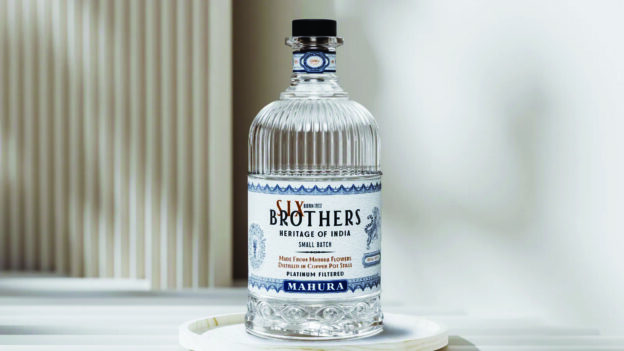
A year later, in April 2024, South Seas introduced Six Brothers Mahura, a spirit born again a century after its first creation. The release was hailed as India’s most exclusive small-batch heritage spirit, limited to 102 bottles priced at ₹1,02,000.

It honours the pioneers whose names crown its label. The blossom once regarded as rustic gained new finesse through double distillation and platinum filtration. In the glass, the spirit reveals warmth balanced with clarity; aromas of figs, raisins, dried hay, ginger, pepper, and apricot. Its taste unfolds in layers: a hint of salinity, traces of fruit, and a whisper of spice that lingers. Its adaptability has made it a favourite among mixologists and connoisseurs alike. Bandra Born in Mumbai has even launched the world’s first dedicated Mahura bar, serving cocktails built entirely around Six Brothers expressions that have become signature draws for the city’s patrons.

Each bottle carries symbols that narrate its ancestry. Six pairs of engraved eyes form a circle at the base; sentinels representing the brothers who began it all. A single all-seeing eye crowns the closure, signifying their shared vision. The tiger that marks the label is not decoration but emblem; a creature drawn from the forests where the mahua blooms, embodying endurance, confidence, and native strength.

To walk through the distillery today is to witness tradition entwined with invention. Rows of casks stand in patient formation, their staves breathing with moisture and craft. Workers test temperature by feel, marking variations in chalk upon wood.

South Seas Distilleries, once a local venture reborn from family lore, now stands among India’s most respected producers of malt and indigenous spirits. Yet the company remains resolutely private in tone, disinterested in corporate spectacle. Its focus lies in substance, a discipline that traces its roots back to 1922, when six brothers dared to dream of distilling the Indian earth itself.

When Hamavand and Rupi speak of the distillery, they describe not a company but an inheritance that breathes. The copper stills remain burnished and loyal. The casks sleep in Dahanu’s humidity, surrendering what they must, preserving what they can. In their aroma lies the persistence of memory; the same fragrance that once enchanted princes, now refined for a global connoisseur.

INDSPIRIT 2024: A New Era for the Alcobev Industry | Inaugural Address by Trilok Desai

INDSPIRIT 2024 and Ambrosia Awards 2024 was held recently in Gurgaon, Haryana in front of a packed audience.

Dive into the heart of the alcobev industry with the inaugural address of INDSPIRIT 2024, delivered by Trilok Desai, the visionary Publisher & MD of Ambrosia & SAP Media Worldwide. As we celebrate the 16th edition of this iconic event, get ready to explore the dynamic shifts and growth trajectories shaping the future of alcohol beverages in India and beyond.

Don’t miss out on this comprehensive overview of today’s alcobev landscape, filled with expert analysis, future forecasts, and a celebration of industry achievements. Whether you’re a professional in the field, an enthusiast, or simply curious about the evolving world of alcoholic beverages, this video promises insights and inspirations aplenty.

Stay Tuned: Subscribe and hit the notification bell to get updates on all things INDSPIRIT 2024. Share your thoughts and questions in the comments below, and let’s engage in enriching discussions on the future of the alcobev industry. 🔗

Follow Us on Social Media for more such reviews & updates on the Alcobev Industry!

Website: https://www.ambrosiaindia.com/

Instagram: https://www.instagram.com/ambrosia_magazine/

X: https://twitter.com/Ambrosia_Mag/

Facebook: https://www.facebook.com/AmbrosiaMagazine/

LinkedIn: https://www.linkedin.com/showcase/ambrosia-magazine/