Crazy Cock Indian Single Malt Whisky has launched Madhuca – The Heritage Editions, a new range finished in Mahura casks. The whiskies are produced at South Seas Distilleries in Dahanu, Maharashtra.
The range uses oak casks that were previously seasoned with Mahua flower spirit. This finishing method introduces flavours derived from Mahua, a flower traditionally used in distillation across parts of India. South Seas Distilleries has produced Mahua flower spirit commercially and applies it here to season casks used for whisky maturation.
South Seas Distilleries has been operational for over a century and has worked with malt whisky for several decades. The distillery uses copper pot stills and matures whisky in tropical conditions, which influence ageing and flavour development. The Madhuca expressions were developed through controlled cask selection and finishing at the distillery.
Madhuca – The Heritage Editions consists of three expressions, each matured in oak casks and finished in Mahura-seasoned barrels. The whiskies share a profile shaped by floral notes, moderate sweetness and spice, with individual variations between expressions. The range is intended for both neat consumption and cocktail use.
The bottle design uses saffron, blue and green colour elements referencing the Indian flag. In addition to the whisky range, a limited release of matured Mahua spirit has been issued, restricted to 102 bottles and priced at ₹1,02,000.
The Madhuca range will be available through select five-star hotels, premium clubs, duty-free outlets and retailers in Mumbai, Gurgaon, Bengaluru and Goa. Madhuca I will be sold exclusively via duty-free. Madhuca II is priced between ₹4,750 and ₹4,850, while Madhuca III is priced between ₹3,590 and ₹3,680.
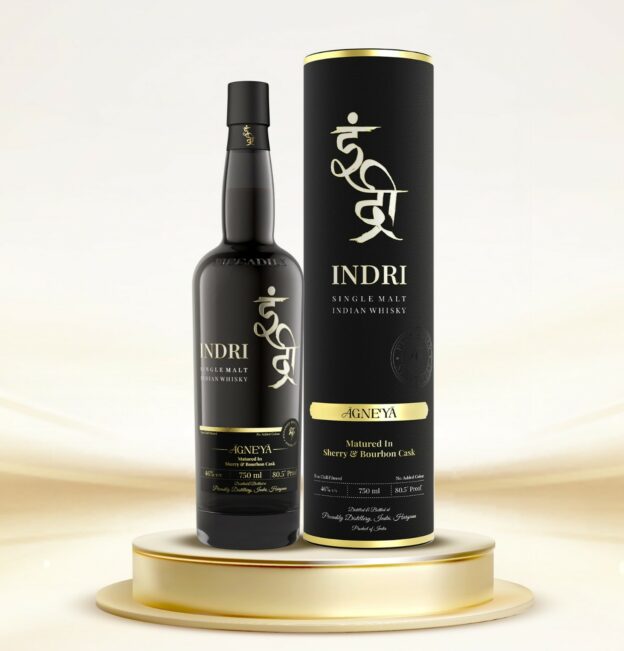
Piccadilly Distilleries launched Indri Agneya recently – a lightly peated expression of its famous Indri Trini Indian Single Malt. That was launched back in 2022 and we reviewed that as well. Indri Agneya is an expression that is slightly different from the original, the Agneya is a dual-cask expression with a peated profile whereas Trini is aged in triple casks.
Price & Availability
Coming back to Indri Agneya – it is produced at Piccadilly’s Indri distillery in Haryana and is priced at ₹3,800 for a 750 ml bottle, with an ABV of 46%. It is currently available in Haryana, Rajasthan, Maharashtra, Himachal Pradesh, Uttarakhand, Delhi, Daman, and Goa, with more states and select international markets joining soon.
The price ranges from Rs. 3,800 – Rs. 8,000 with the most expensive being in Maharashtra.
How It’s Made
The name “Agneya” comes from Sanskrit, meaning “belonging to fire,” a nod to its smoky character. This expression uses indigenous six-row barley and is matured in Sherry and Bourbon casks.
According to Master Blender Surrinder Kumar, this is one of the most refined single malts they’ve made to date. The barley is gently kilned over peat smoke, allowing smoke to enhance rather than dominate the spirit. This ensures the whisky stays balanced and doesn’t lean too heavily on smoky intensity — a common challenge with peated malts.
Packaging
Agneya comes in a bold black bottle that stands out from the Trini’s design. The label highlights that it’s non-chill filtered and has no added colour. It even mentions that the whisky might appear slightly cloudy in cooler climates, completely natural.
The whisky itself has a deep, dark brown hue and the bottle design, with its striking black cap, gives it a premium, confident look.
Nosing
Light smoke
Delicate chocolate & vanilla sweetness
Warm spice
Fruity flavour – possibly apple and apricot
Earthy peat dust
Tasting
Sweet profile, toffee nutty flavour with gentle spice
Warm wave of peat smoke
Long finish with bite of spice
Conclusion
How is Indri Agneya? At Rs. 3,800 it is Picadilly’s bold expression.
Peated whiskies are usually an acquired taste, but this one feels refined and inviting. If you’re a fan of Indri or curious about exploring peated malts without going full Islay-style, this is definitely worth trying. It’s a confident step forward in India’s single malt journey and one that whisky lovers will appreciate.
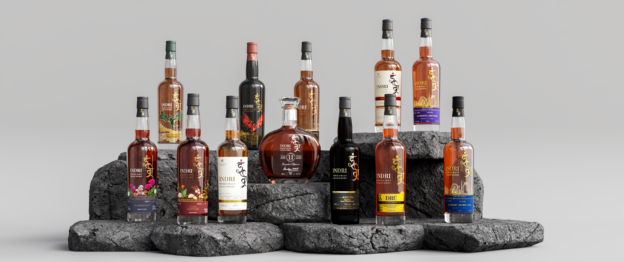
Indri, the single malt whisky from Piccadily Agro Industries, sold 2.04 million bottles (approximately 1,70,000 nine-litre cases) in 2024, placing it as the best-selling single malt in India. Of this, 1,24,000 cases were sold domestically and 46,000 were exported. The International Wine & Spirits Record (IWSR) confirms these figures and ranks Indri as the leading malt whisky in the Indian market.
The brand’s lineup includes expressions such as Indri-Trini (three-wood matured), cask-strength Indri-Dru, the Diwali Collector’s Editions, and the Founder’s Reserve 11-Year-Old. These expressions have received recognition at global spirits competitions.
PAIL’s distillery in Indri, Haryana covers 168 acres and produces malt, extra neutral alcohol (ENA), ethanol and white crystal sugar. Besides Indri, the company also offers blended malts and Camikara, an aged sugarcane juice-based rum.
Launched in 2022, Indri has witnessed rapid growth, strengthened by both domestic momentum and expanding export reach. The company now aims to place the brand among the world’s top five single malts in the coming years.
With growing global demand for Indian spirits and a shift toward premiumisation, Indri’s performance highlights how India’s single malt segment is steadily carving its place on the international whisky map.
Piccadily Distilleries has launched Indri Agneya, a lightly peated version of their Indri Indian Single Malt Whisky – aiming to bring a bold new dimension to the industry. The name for the malt ‘Agneya‘ is derived from the Sanskrit word meaning ‘belonging to fire’.
Indri Agneya is now available in Haryana at an MSP of Rs. 3800 and will be rolled out across premium retail outlets in India, global travel retail and select international markets in the coming months.
Maturation
The lightly peated version draws its character from maturation in both Sherry and Bourbon casks. According to the Master Blender Surrinder Kumar, the dual-cask aging imparts a layer of depth and complexity, evoking the elemental interplay of fire and wood. And the makers feel that this is the most refined Indian single malts that they’ve made to date.
Agneya is matured in select American oak casks that enhance its bold character adds Kumar. The indigenous 6 row barley is gently kilned over peat smoke, resulting in a spirit that imparts a whisper of smoke that enhances rather than dominates. This balance of peat, sweet malt, toasted oak and spice makes Indri Agneya a compelling choice for those curious about smoky whiskies – albeit the heaviness from peated malts.
Nosing
On the nose, it reveals rich notes of nuttiness and ripe fruit with a smooth, rounded texture, culminating in a gentle lingering smokiness. And it is this this smokiness that sets the Agneya apart from its flagship Indri-Trini. The makers feel that this expression redefines the spectrum of Indian single malts – delivering innovation, balance and sophistication in every sip.
Piccadily feels that Indri Agneya is more than just a product, it represents the makers bold ambition – to elevate Indian single malts on the global stage and continuously redefine the category. It is a reflection of India’s growing reputation for producing exceptional, terroir-driven whiskies that can compete with the best in the world.
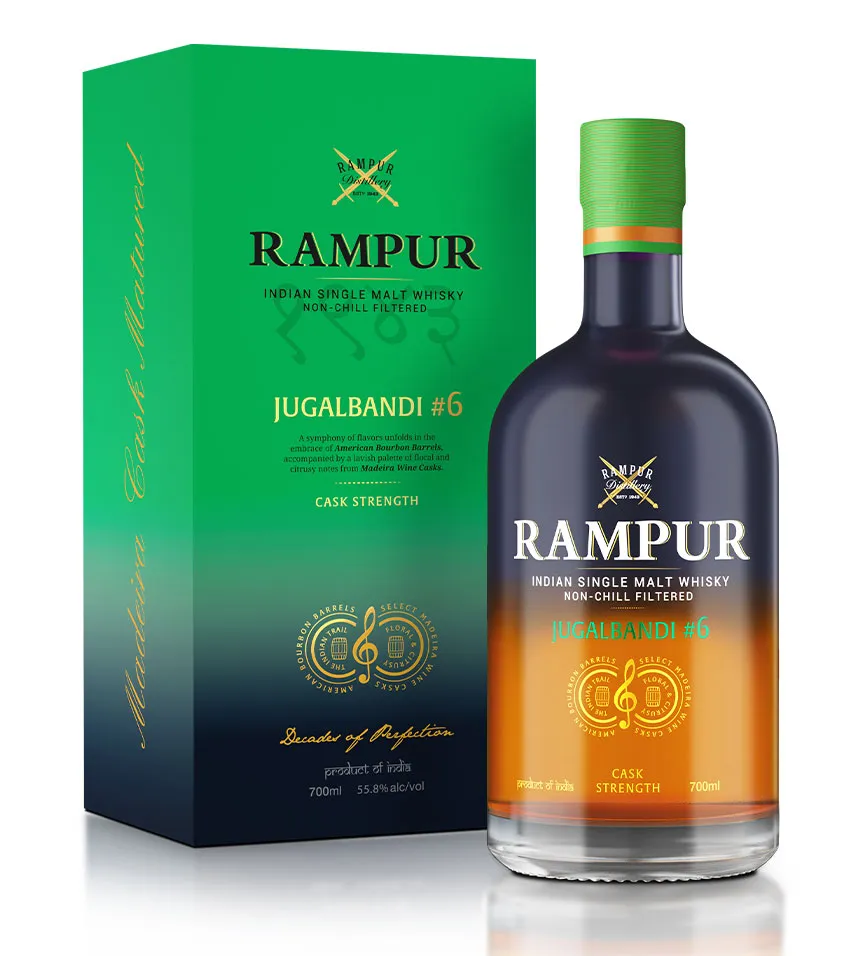
Rampur Jugalbandi #6, a limited edition Indian whisky has been named ‘Best World Single Malt’ at the 2025 John Barleycorn Awards held in the United States. The John Barleycorn awards are considered one of the most prestigious events in the global spirits world, and are judged by seasoned writers and industry experts.
Aside from this recently launched single-malt, two other Indian whiskies have also bagged awards for ‘Double Gold’ and ‘Gold in the Indian Single Malt Whisky – Tokaji Finish category’, respectively. Rampur Select secured a Double Gold, while Jugalbandi #5 earned Gold in the Indian Single Malt – Tokaji Finish category.
The Rampur Jugalbandi #6 is aged in rare Madeira casks in the north Indian climate, to attain the classic characteristics of the Rampur Single Malt whiskies.
Taste
The Jugalbandi series, #6, carries a pleasing aroma of floral and citrus notes, with a medley of fruits and caramelised pineapple and apricot on the palette. The alcohol by volume is 55.8 per cent.
Currently, this limited-edition Indian whisky is available in the Ospree Duty Free at Terminal 2 of Chhatrapati Shivaji Maharaj International Airport, Mumbai, and the duty-free at Terminal 3 of Delhi’s Indira Gandhi International Airport.
Rampur Select was awarded Double Gold for its signature smoothness and fruit-forward character. It is priced Rs. 12,500 for a 750 ml bottle. The blend is aged in the foothills of the Himalayas and is described as the ‘Kohinoor of Single Malts’ by the brand. Rampur Jugalbandi #5 received a Gold for its elegant and experimental cask finish and is matured first in American Bourbon barrels and then Tokaji wine casks, which infuses the liquid with fruity, floral and honeyed notes. The official MRP has not been disclosed.
Rakshit Jagdale, the Managing Director of Amrut Distilleries in a podcast conversation with Bhavya Desai talks about how the 75-year-old company has evolved over the years, starting from heritage brands such as Amrut XXX rum and Silver Cup brandy in the 1950s to the Amrut Single Malt and now to a limited edition of the oldest whisky from the sub-continent – The Expedition.
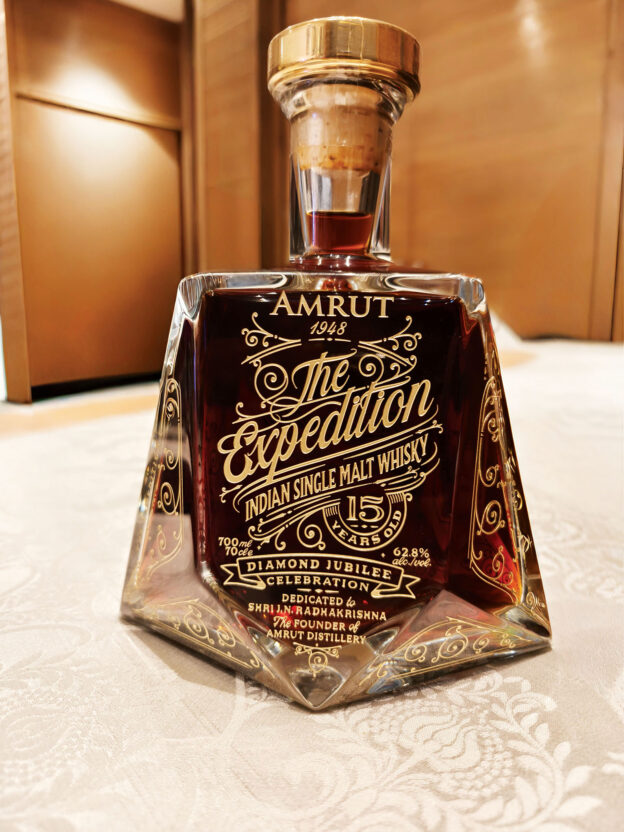
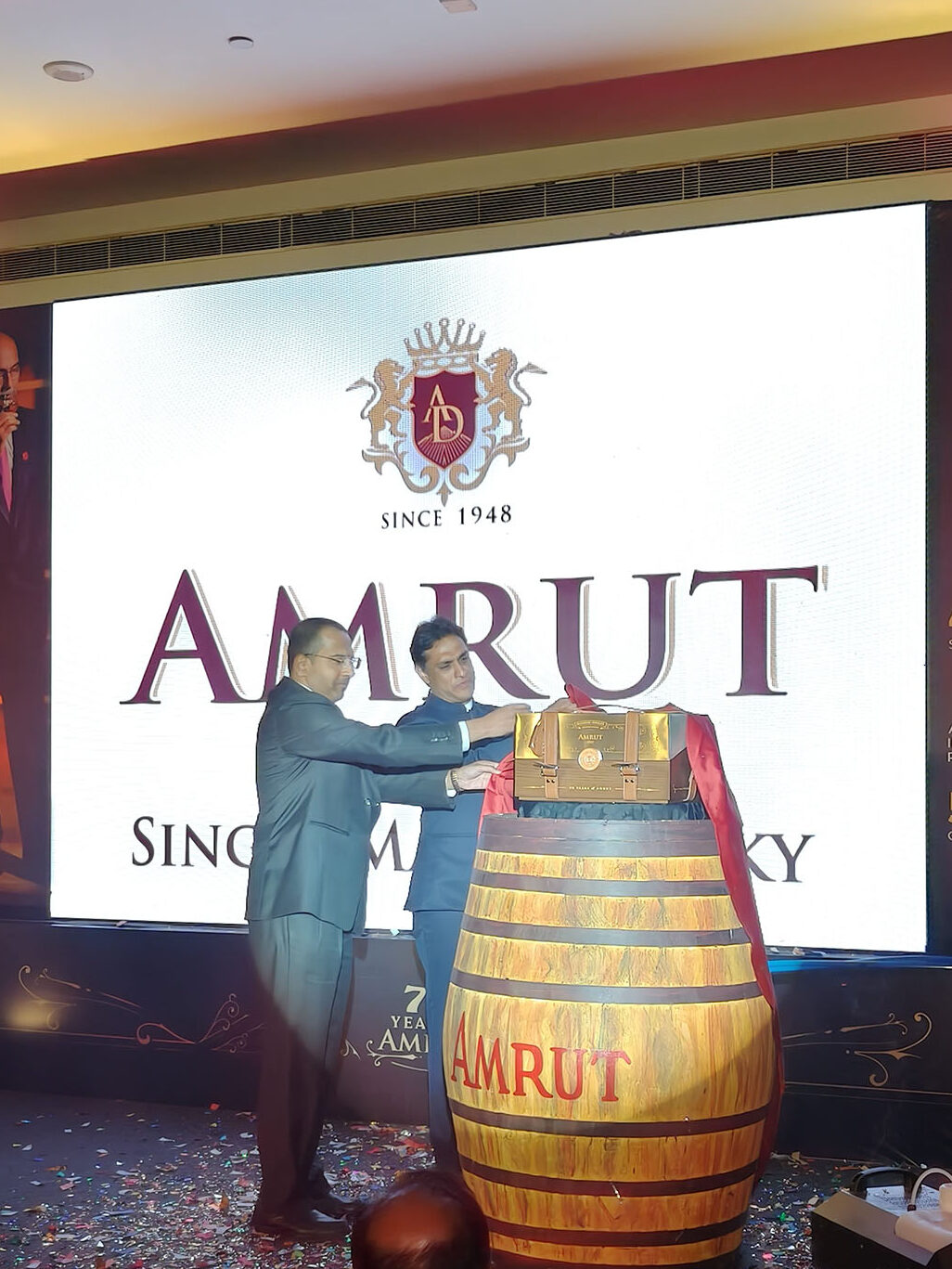
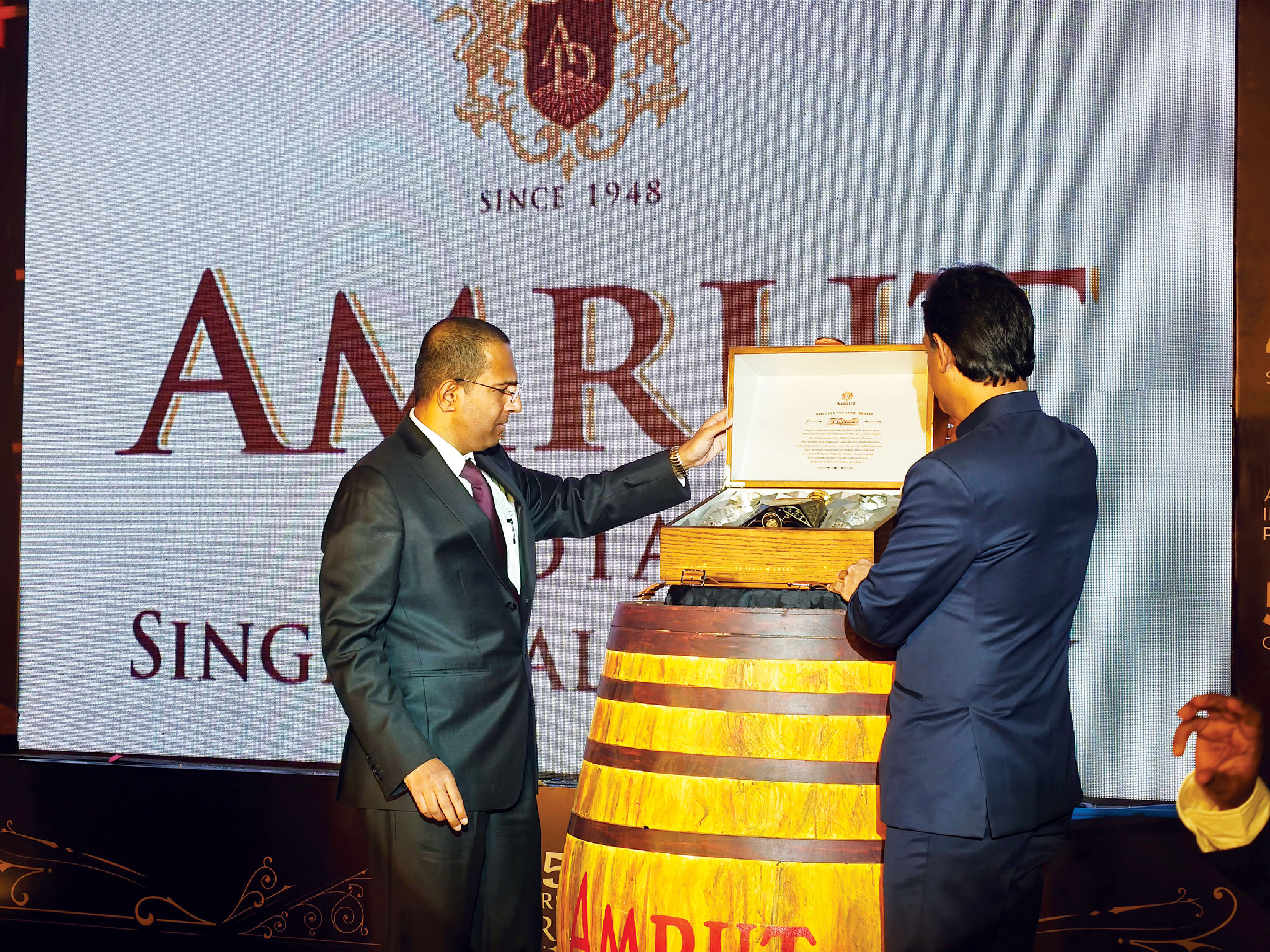
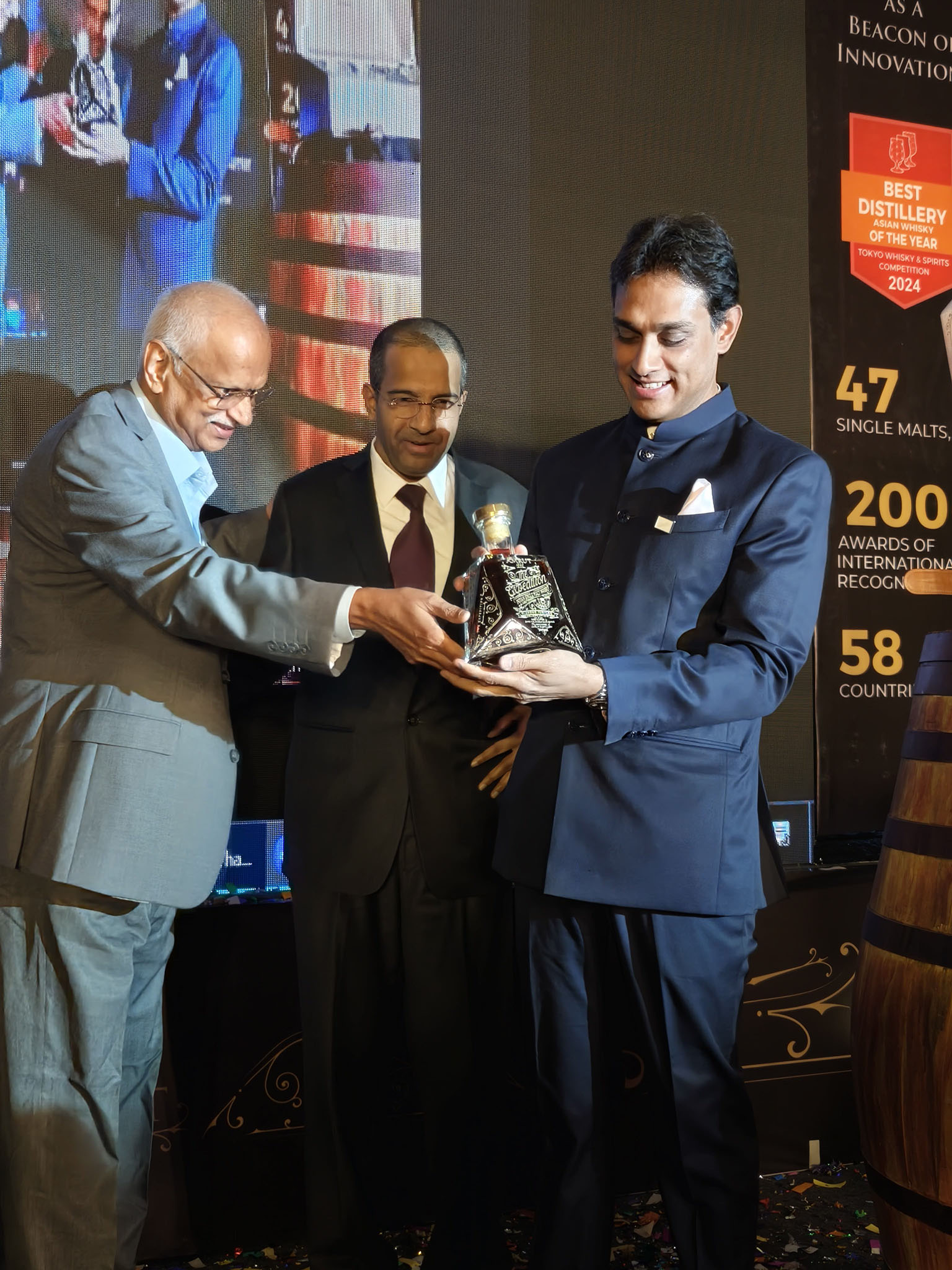
On February 26, 2025, Bengaluru-based Amrut Distilleries reached yet another highpoint in the alcobev sector when it launched The Expedition, the oldest single malt whisky in India, matured for 15 years, and sold for 12,000 USD (₹10.50 lakhs) per bottle. Celebrating its 75th anniversary, Amrut Distilleries released 75 bottles of this rare whisky, 66 of it for the international market and the rest for the Indian market.
Matured for 15 years
The Expedition is matured for 15 years, initially in European Sherry casks for 8 years and then American Bourbon casks for 7 years, developing deep, opulent flavours, complexity and depth. Amrut’s Expedition packaging exudes the grandeur of a royal heirloom. The merging of metal and wood took six months. Each handcrafted box houses an individually engraved and numbered bottle, featuring a diamond-cut design with intricate gold engravings. A regal silver peg measure, crafted by a Bangalore silversmith, has been embedded with a near-field communication (NFC) tag and authentication card.
Globalisation and the Market
Not just The Expedition, the international market for Amrut has been the US, followed by Europe and the APAC region, the last one is fast growing for single malt whiskies. “It has been a very exciting time for us in the industry now. We should see how it will unfold,” Rakshit said and mentioned how the markets opened up in India in 1990-91 with globalisation. “Seagram’s came with advertising blitzkrieg for Royal Stag, something which we had not seen. People started shifting from drinking heavier blended whiskies like MaQintosh or Peter Scot or Royal Challenge into drinking lighter whiskies like Royal Stag. At Amrut, we did not stop distilling, we kept on maturing our malts.”
Lighter Whiskies
It was around 1995-96 that Amrut cut down using heavier malts in MaQintosh from 35% to 10% to 8%. “It was then we thought why not go for single malt whisky, why not explore.” The first batch was matured for four years average and now the company is using a larger percentage of older whiskies. “We don’t have that much of quantity, we run out of supply,” confesses Rakshit.
Denying that the company created a demand to jack up prices and make it luxury, Rakshit said, “We didn’t have enough whisky, even now it is the case, but we do come up with special edition whiskies. Who wouldn’t want to sell more of their product.”
Technologies at play
Talking about how the company has evolved over the years, Rakshit said, “Techniques have evolved and barleys have improved from two row to six row. The yeast varietals have undergone massive change. Distillation technologies have also improved. The world over, the yield per ton of malt spirit has improved significantly now. Earlier, we were probably touching around 350 to 360 alcoholic litres per tonne, we are now hitting close to 400 alcoholic litres per tonne. With Scottish malts it’s even higher going up to 415 to 425 litres per tonne.”
On location advantage, Rakshit said Bangalore at an altitude of 950 metres above sea level has significant advantage with relative humidity remaining high in summer and dropping significantly in winter. “We lose angel’s share in our warehouses at an average of 9% every year. Probably it doesn’t happen anywhere else, may be in Kentucky. We lose more water than alcohol. If you go down anywhere near the coast or if you mature in Scotland, it is the other way around, because in Scotland’s cooler clime, the angel’s share is 2% per year, but they lose more alcohol than water, with the strength dropping. Humidity and altitude play a very significant role for us.”