
Tag Archives: alcohol distribution

Amrut Expands Luxury Portfolio in North India with IGL Partnership

Bengaluru-based Amrut Distilleries has rolled out an expanded portfolio of high-end Indian single malts across Delhi and Uttarakhand, with Uttar Pradesh next in line. The rollout is being executed through a strategic distribution and marketing partnership with India Glycols Ltd (IGL), one of the country’s largest extra neutral alcohol (ENA) producers.


The move marks Amrut and IGL’s transition from the premium category into the luxury malt space in key North Indian markets, targeting both high-value consumers and institutional buyers, while leveraging IGL’s financial strength, logistics, and market reach.
Explaining the rationale behind the move, the Executive Director of Amrut Distilleries, Thrivikram. G. Nikam said “Prior to partnering with IGL, we were operating through a local distribution arrangement, with a strong focus on our premium portfolio. At that time, we were selectively present in the northern markets, primarily testing the waters with our higher-end offerings. However, following changes in the excise policy in Delhi we decided to discontinue operations and reassess our approach to the region. Now with IGL we have reintroduced our Luxury Malt brands.”


India Glycols operates ENA manufacturing facilities in Kashipur and other locations, supplying high-quality extra neutral alcohol to leading spirits brands across the country. ENA is transported from northern India to southern markets such as Karnataka due to its consistency and quality, despite the presence of local distilleries. Amrut sources ENA from India Glycols. IGL already supplies ENA for the production of nearly 2 lakh cases per month at its bottling facilities and has been producing premium alcohol for over 15 years. The company also owns brands such as Amazing Whisky, Amazing Vodka, and Zumba Limon, but had largely remained an upstream supplier before entering branded spirits in a bigger way.


Amrut Open to Partnerships
To the question whether Amrut would be open for similar arrangements, Nikam confirmed “Yes, as part of our growth strategy, we remain open to partnering with strong, credible promoters in other regions as well. Our focus is to work with partners who share our values and have a deep understanding of their respective markets. This approach will guide our expansion into remaining states over time.”
Raju Vaziraney, President of IMFL at India Glycols said that recognising the challenge of launching new whisky labels in a market driven by heritage and credibility, IGL opted to partner with Amrut rather than create a new single malt brand from scratch.


New Launches: Capital, Double Cask and Exclusive Editions
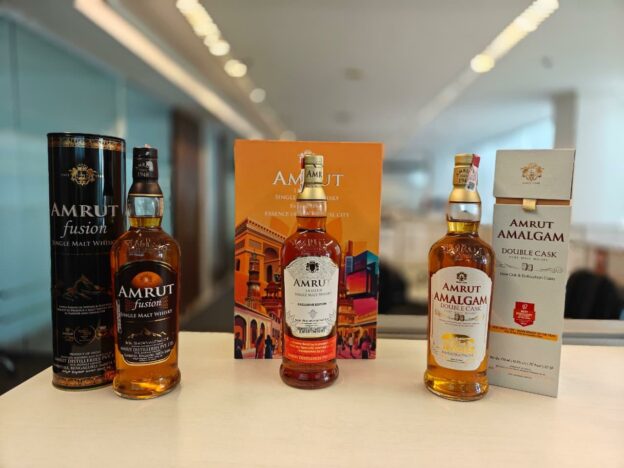
Vaziraney mentioned that in Delhi, three luxury expressions have been rolled out. They are Amrut Fusion – the flagship, internationally awarded Indian single malt; Amrut Amalgam Double Cask – an upgraded and more refined version of Amalgam, featuring new premium magnetic packaging; and Amrut Exclusive Edition – Capital Edition – a city-specific luxury malt positioned among the highest-priced Indian single malts.
In Uttarakhand, four variants have been introduced Amrut Fusion; Amrut Amalgam Double Cask; Amrut Exclusive Edition – Silver Jubilee Edition, commemorating 25 years of the state’s formation; and Amrut Amalgam Peated, catering to consumers who prefer smoky malt profiles.
Uttar Pradesh is scheduled for launch within the next month, with three luxury variants already approved under the agreement.


Export-Grade Quality
To align with international benchmarks, Amrut has increased alcohol strength for these markets with Fusion and Amalgam: 44.1% ABV (up from the usual export 42.8%) and Exclusive Editions: 48% ABV. He reiterated that the same malt quality supplied to export markets is being offered domestically, reinforcing its premium and luxury positioning.
The partnership is targeting aggressive growth in North India. Amrut and IGL are aiming to rank among the top three Indian single malt brands in key markets such as Delhi, UP, and Uttarakhand, with a 20% market share target in these regions.
With India’s single malt category continuing to grow rapidly both at home and abroad, the Amrut–IGL alliance signals a new phase of consolidation, premiumisation, and financial discipline in North India’s high-end spirits business.
Chandrababu Naidu

Andhra Pradesh’s New Excise Policy; Retail Back with Private Players

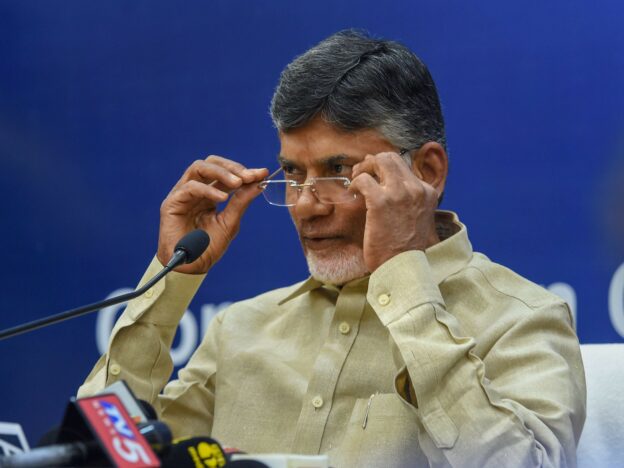
The Andhra Pradesh government led by N. Chandrababu Naidu on September 18 announced a new excise policy to come into effect from October 1, 2024, the highlights been retail sale by private players; availability of cheaper select brands starting from Rs. 99; setting up of premium liquor stores and expecting to generate revenue of Rs. 2,000 crore per year.

Reversing the decision of the previous YSR Congress Party (YSRCP) run government, the TDP government has claimed that there was a revenue loss of Rs. 18,860.51 crores from 2019 to 2024 due to a skewed policy. The AP government has fixed price of affordable liquor at Rs 99. The allocation of licenses will be done through an online lottery, and four license categories have been fixed with fees ranging from Rs 50 lakh-Rs 85 lakhs.

In a white paper, released earlier, the TDP said that the non-availability of Indian-made foreign liquor (IMFL) brands had resulted in an increase in sales of poor-quality brands and spurious substances. It may be mentioned that the YSRCP had promised prohibition in Andhra Pradesh in 2019, but only imposed restrictions on the liquor trade instead of complete prohibition.

Premium Liquor Stores To Get Nod

The new excise policy will be in force for two years. It will also allow for the setting up of premium liquor stores and alignment of liquor prices with Telangana and Karnataka. It also decided to reserve 10% retail outlets for toddy tappers and to open premium shops at 12 locations other than Tirupati.

The Minister for Information and Public Relations  K Parthasarathi said the NDA alliance promised to bring an excise policy that ensures the quality of liquor at affordable price. He alleged several irregularities took place in the previous government in sale of liquor at every stage.

“The cabinet decided to adopt a private retail system for sale of liquor as part of an attempt to increase management efficiency. Of the 3,736 retail outlets in the state, 10 per cent will be allotted to the toddy-tappers community.”

The new government expects to generate additional excise revenues following the implementation of the policy. In fact, Andhra Pradesh had seen a gradual growth year-on-year in excise revenue, up from Rs 17,473 crore in 2019-20, escalated to Rs 23,785 crore in 2022-23 fiscal, even as the YSRCP government was working on reduction in the consumption of alcohol.

Reversing Previous Government Notification

The previous government in a notification in November 2023 had avowed policy of reduction in the consumption of alcohol levels in the State. In order to realize the objective, the Government had taken several measures such as removal of belt shops, dispensing with permit rooms, which are meant for consumption of liquor in the vicinity of shops, removal of private players from the retailing by shop etc.

YSRCP Had Reduced Shops By About 33%

Further, the A.P. State Beverages Corporation Limited had been granted exclusive privilege of retailing of IMFL and Foreign Liquor by the shop from the appointed date i.e. 01.10.2019. Further, the Government had reduced the number of shops to 2934 i.e. by about 33%. Keeping in view the policy imperative and after careful examination of the proposals submitted by the Commissioner of Distilleries and Breweries & Managing Director, the A.P. State Beverages Corporation Limited decided that it will continue the retailing of IMFL & FL through the retail outlets.

The licence period of the Shops shall be one year from 01.10.2023 to 30.09.2024 with the Commissioner of Prohibition & Excise empowered to renew the existing retail outlets run by the APSBCL under Rule 8 of the A.P. Excise (Grant of licence of selling by shop and conditions of licence) Rules, 2019 on payment of annual licence fee.   The policy also said there will be no permission or renewal for shops on the road from Tirupathi Railway Station to Alipiri via RTC Bus Stand, Leelamahal circle, Nandi circle, Vishnu Nivasam, Srinivasam. Likewise, no Shop shall be permitted on the road from Leelamahal – Nandi circle – Alipiri – SVRR Hospital – SVIMS in Tirupathi Municipal Corporation area.

The APSBCL shall be permitted to establish walk-in shops (Elite Shops) in the State as per the requirement but without any change in the number of retail outlets permitted. The previous policy also mentioned that it would take up campaigns to educate the public on the evils of consumption of liquor and other intoxicants.