
Tag Archives: Trade Magazine

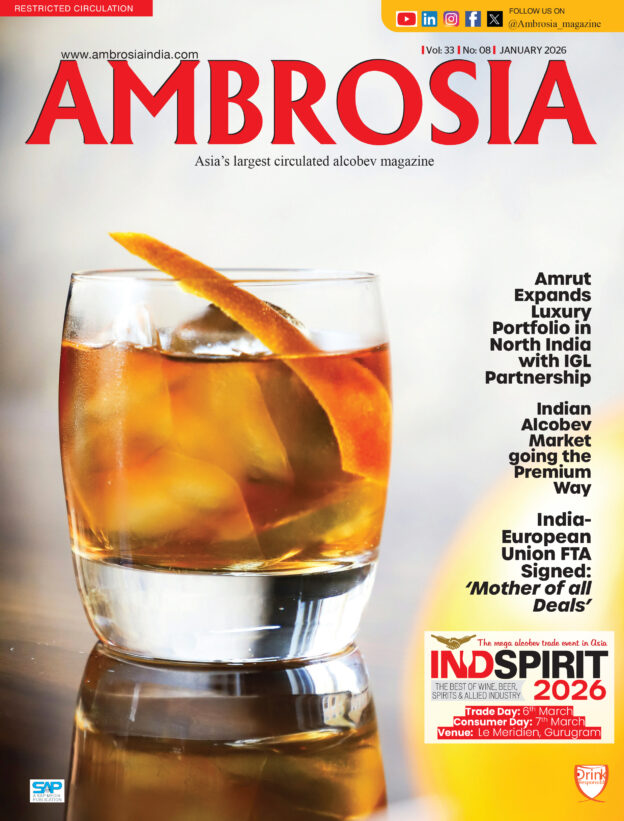
January 2026 Issue

The January 2026 issue of Ambrosia Magazine is live! (Click Here)

It features engaging and insightful articles such as:

• India-European Union FTA Signed: Mother of All Deals
• Indian Alcobev Market going the Premium way
• @amrutmalt.global Expands Luxury Portfolio in North India with IGL Partnership
• Why India Matters to HiteJinro (@hitejinrobeverage) Now and How Monika Alcobev fits into Jinro (@jinro_global) Soju’s plan jinro
• @airindia unveils a refreshed beverage colection featuring celebrated wines and spirits from across the world
• Johnnie Walker Blonde Lemonade (@johnniewalkerindia) sponsors Lollapalooza India (@lollaindia) 2026
• Maharashtra signs ₹500-crore Investment MoU with @carlsbergindia at Davos
• Exclusive interviews with Heemanshu Ashar, Global Ambassador for Paul John Single Malt, Karishma Manga Bedi, Founder & CEO of Those Good Distillers and more.

Read 1 year of the e-magazine for FREE — register on www.ambrosiaindia.com

India-EU FTA Signed:
Has the Game Officially Changed?

With the ink now dry on the India-EU Free Trade Agreement, the alcobev industry has crossed a threshold it has waited decades for. This is no longer a policy discussion or a negotiation headline-it is a structural reset for how India
trades, consumes and thinks about wine and spirits. At the centre of the agreement lies a long-standing friction point: import duties.
While the FTA does not open the floodgates overnight, it formally commits both sides to phased and predictable tariff reductions on wines and spirits from the European Union. That clarity alone is transformative. For the first time, global producers, Indian importers, and domestic players can plan with certainty rather than hope. While the detailed provisions of the agreement are awaited, the initially released agreement indicates that the proposed reduction in import tariffs from the current 150% to 75% across all EU spirits & wines categories from the entry into force of the agreement, is a clearly welcome development. The agreement further outlines that the tariffs will then be lowered to 40% for spirits and as low as 20% on wines in a phased approach.
For European alcobev companies, India has officially moved from ‘high-potential but high-risk’ to strategic priority market. Reduced duties allow portfolios—not just prestige labels—to enter India meaningfully. Expect greater depth across categories: accessible Scotch and Irish whiskies, wider Cognac ranges, Champagne beyond celebration moments, and European wines that finally sit at dinner tables rather than behind glass cabinets.
Indian producers, understandably, will feel the heat. But this deal is not a death knell for domestic brands—it is a reality check. Protectionism has limits, and Indian distillers have already shown they can compete on quality, narrative, and innovation. The FTA will accelerate a necessary shift: from surviving behind barriers to winning on merit.
Wine may be the biggest long-term beneficiary. With duties easing, imported wines are likely to enter more realistic price brackets, fuelling everyday consumption and education. However, this could also possibly mean curtains for many Indian Wine producers. And that matters because wine builds culture before it builds volume—and India needs both.
Of course, the agreement does not erase India’s internal complexities. State taxes, distribution bottlenecks, and regulatory fragmentation remain. But the FTA wasn’t designed to solve everything. It was designed to set direction. And the direction is clear. India has chosen integration over insulation. Europe has chosen engagement over hesitation. For the alcobev industry, this isn’t just a trade deal—it’s the moment the market officially grew up.

December 2025 Issue

The December 2025 issue of Ambrosia is now live! (Click here)

The December 2025 issue of Ambrosia Magazine is here!

It features engaging and insightful articles such as:

• INDSPIRIT 2026
• What to expect in 2026
• Updates on the MML vs ISWAI case
• Pernod Ricard: India’s bet on repertoire drinking
• India’s alcohol economy in 2025: Scale, state power, and structural friction
• Court allows PLL holders to register labels, pending final order
• Exclusive interviews with Pernod Ricard and Bacardi, and many more

As 2026 Beckons: Reading the Signals of a Changing Alcobev India

INDSPIRIT 2026 and Tunes & Tonic Announced

If the final month of this year is anything to go by, 2026 promises to arrive with more than just optimism — it comes with momentum. The year gone by has been anything but quiet for India’s alcobev industry. From the Maharashtra government’s face-off with ISWAI to intense conversations around state control, taxation, and regulatory balance, 2025 has underlined how scale, state power, and structural friction continue to define this business. Yet, amid these challenges, the industry has also demonstrated resilience, adaptability, and an unmistakable appetite for growth.

Throughout the year, Ambrosia has stayed at the forefront of these developments — tracking policy shifts, decoding consumer behaviour, and spotlighting growth stories that make India’s alcobev landscape one of the most dynamic in the world. It is an industry shaped as much by regulation as it is by aspiration, and one that continues to evolve at a pace few global markets can match.

And speaking of consumer behaviour, 2026 will also mark the 21st edition of INDSPIRIT 2026, alongside the debut of Tunes & Tonic, a new consumer-facing experience set to take place in Gurugram on 6–7 March 2026. Together, these events promise to be bigger, bolder, and more immersive — celebrating the industry’s achievements while creating an energetic, music-led atmosphere that resonates with today’s experience-driven consumer.

In this issue, we continue that focus. Our editorial lens turns firmly toward the year ahead, unpacking insights that help decode where the Indian consumer is headed in 2026. From changing drinking occasions and premiumisation to the growing influence of moderation, mixers, and experience-led consumption, these stories are designed to help brands, distributors, and industry stakeholders plan better — whether that means sharper portfolios, smarter strategies, or more meaningful consumer engagement.

For those looking to understand the year that was, our feature India’s Alcohol Economy in 2025 offers a comprehensive snapshot of the forces that shaped consumption, regulation, and market sentiment. Built on perspectives from industry leaders, the article captures both the pressures and possibilities that defined the past year.

Equally compelling are our conversations with Jean Touboul, CEO of Pernod Ricard India, and Inderjit Singh Dhingra of Bacardi. Their insights shed light on how consumer preferences are shifting, how brands are responding, and what trends are likely to shape portfolios and conversations in the year ahead.

As the industry steps into a new year, one thing is clear — 2026 will reward those who listen closely to the market, adapt swiftly to change, and remain committed to quality and relevance. The challenges are real, but so are the opportunities. At Ambrosia, our endeavour remains unchanged: to inform, to question, and to provide clarity in a fast-evolving landscape. As the next chapter unfolds, we look forward to chronicling an industry that continues to redefine itself — one decision, one policy, and one drink at a time.