
Tag Archives: MML

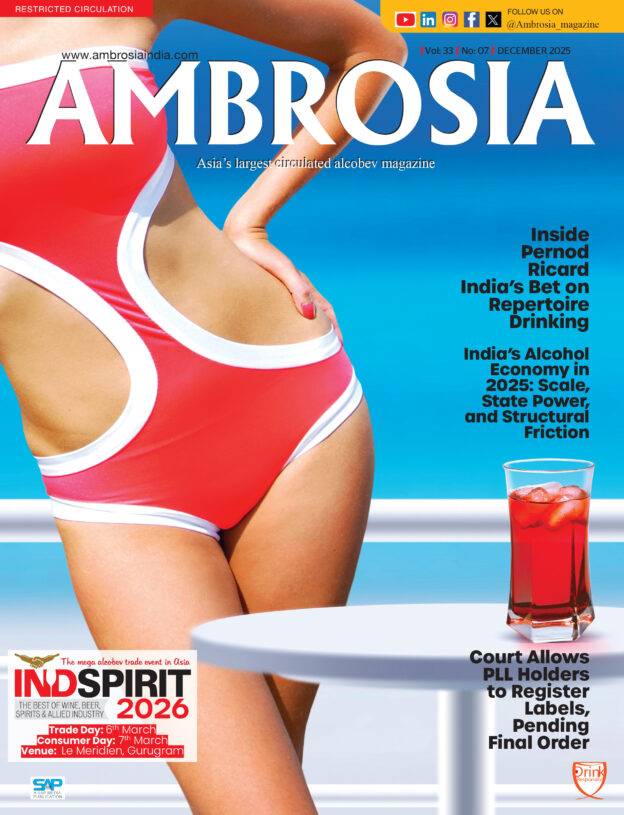
December 2025 Issue

The December 2025 issue of Ambrosia is now live! (Click here)

The December 2025 issue of Ambrosia Magazine is here!

It features engaging and insightful articles such as:

• INDSPIRIT 2026
• What to expect in 2026
• Updates on the MML vs ISWAI case
• Pernod Ricard: India’s bet on repertoire drinking
• India’s alcohol economy in 2025: Scale, state power, and structural friction
• Court allows PLL holders to register labels, pending final order
• Exclusive interviews with Pernod Ricard and Bacardi, and many more

As 2026 Beckons: Reading the Signals of a Changing Alcobev India

INDSPIRIT 2026 and Tunes & Tonic Announced

If the final month of this year is anything to go by, 2026 promises to arrive with more than just optimism — it comes with momentum. The year gone by has been anything but quiet for India’s alcobev industry. From the Maharashtra government’s face-off with ISWAI to intense conversations around state control, taxation, and regulatory balance, 2025 has underlined how scale, state power, and structural friction continue to define this business. Yet, amid these challenges, the industry has also demonstrated resilience, adaptability, and an unmistakable appetite for growth.

Throughout the year, Ambrosia has stayed at the forefront of these developments — tracking policy shifts, decoding consumer behaviour, and spotlighting growth stories that make India’s alcobev landscape one of the most dynamic in the world. It is an industry shaped as much by regulation as it is by aspiration, and one that continues to evolve at a pace few global markets can match.

And speaking of consumer behaviour, 2026 will also mark the 21st edition of INDSPIRIT 2026, alongside the debut of Tunes & Tonic, a new consumer-facing experience set to take place in Gurugram on 6–7 March 2026. Together, these events promise to be bigger, bolder, and more immersive — celebrating the industry’s achievements while creating an energetic, music-led atmosphere that resonates with today’s experience-driven consumer.

In this issue, we continue that focus. Our editorial lens turns firmly toward the year ahead, unpacking insights that help decode where the Indian consumer is headed in 2026. From changing drinking occasions and premiumisation to the growing influence of moderation, mixers, and experience-led consumption, these stories are designed to help brands, distributors, and industry stakeholders plan better — whether that means sharper portfolios, smarter strategies, or more meaningful consumer engagement.

For those looking to understand the year that was, our feature India’s Alcohol Economy in 2025 offers a comprehensive snapshot of the forces that shaped consumption, regulation, and market sentiment. Built on perspectives from industry leaders, the article captures both the pressures and possibilities that defined the past year.

Equally compelling are our conversations with Jean Touboul, CEO of Pernod Ricard India, and Inderjit Singh Dhingra of Bacardi. Their insights shed light on how consumer preferences are shifting, how brands are responding, and what trends are likely to shape portfolios and conversations in the year ahead.

As the industry steps into a new year, one thing is clear — 2026 will reward those who listen closely to the market, adapt swiftly to change, and remain committed to quality and relevance. The challenges are real, but so are the opportunities. At Ambrosia, our endeavour remains unchanged: to inform, to question, and to provide clarity in a fast-evolving landscape. As the next chapter unfolds, we look forward to chronicling an industry that continues to redefine itself — one decision, one policy, and one drink at a time.
Bombay High Court Directs Maharashtra to Open Portal for Label Registration

The Bombay High Court has directed the Government of Maharashtra to open the excise department portal for online registration of labels for all alcobev companies, a request filed by the advocates representing the International Spirits and Wines Association of India (ISWAI). This is a temporary directive, pending the hearing of the case filed by ISWAI against the State Government. The next hearing of the case is on December 16. ISWAI went to court, seeking, among other issues, a level playing field in the manufacture of ‘Maharashtra Made Liquor’ (MML).
The Court on November 24 had directed the Government representatives to open the portal for any alcobev player from within the state. However, till December 9, the excise department had not facilitated that process, forcing the Court to take notice of that and cautioning the government. A two-judge bench headed by Senior Judge Revathi Mohite Dere asked why the excise department had not followed the court directive and cautioned the government that it would take serious notice of the lapse.Sources in the Excise Department clarified that the portal is open for anyone to file an application for registering their labels, but it is the department’s prerogative to accept or reject the application.
Only the application for label registration will be accepted once the applicant fits in into the Guideline criteria set by the government. As of now 13 manufacturers are eligible and got the permission to produce MML.

The ISWAI contention has been that the process for companies to get their labels registered is time-consuming, not less than 45 days, and with the court case going on there would be further delay. This, the ISWAI source mentioned would give undue advantage to the eight players who have been granted licenses to set up MML units. They are already marketing MML in the price band of Rs. 160 and Rs. 205 where brand really does not matter to a particular segment of consumers.
As of now, reports from the ground indicate that the products launched under the MML category are doing ‘extremely well’ with product quality being good. Some of the MML players or the consultants who are guiding them come with enormous experience in the liquor industry, either having worked in major companies or having bottling plants or ethanol units. Some of them also own retail shops across Maharashtra where they can give good shelf position for their products.
The ISWAI source said that many of the players were ‘commodity players’ and not ‘brand players’ and they would flood the market having a good lead over the established companies. The source acknowledged that the MML players had drafted consultants who have had strong background in the liquor business and are helping the licensees to set up the businesses, thus giving ‘undue advantage’ to them.
ISWAI went to the court stating that some domestic and international players were producing brands in Maharashtra and selling exclusively in the state and hence should be considered a local player, a criteria to get MML license.
In mid-2025, the Maharashtra government introduced policy changes to incentivise local investment. It brought in the MML category, to include grain-based spirits produced exclusively by local manufacturers. The tax rate for MML is 270 per cent with zero foreign investment/ownership. The government believes that this will spur the local industry.
ISWAI then filed a lawsuit against the Maharashtra government, challenging the sharp hike in excise duty on premium affordable liquor brands and also for exclusion of brands of major players such as Diageo India and Pernod Ricard India from the newly-created lower tax category of MML. ISWAI is represented by Darius Khambatta and Rohan Shah.
The court also asked the government lawyer why the report of the Varsha Nair Committee was not submitted earlier on MML. The report highlights certain salient points to encourage those distilleries which are closed or underutilised in Maharashtra to produce cheap liquor. The report added that this would generate additional revenue to the excise department as well as generate employment provided it is made in Maharashtra for distribution in Maharashtra. It also prescribes certain minimum shareholding pattern for owners.

So far, the department has approved 13 licenses and many more are pending. Companies like Radico Khaitan; Diageo India; Pernod Ricard India and some more are keen on jumping on to this bandwagon to produce economy liquor priced between Rs.160 and Rs.205 for the Maharashtra consumers even while their focus is on premium brands. These companies could launch similar products in this price range with some brand extensions and so on.
The State government is insisting that the policy changes will fetch in more revenue, encourage local industry and create new jobs. MML category is expected to fetch additional excise revenue of Rs. 3,000 crores.