
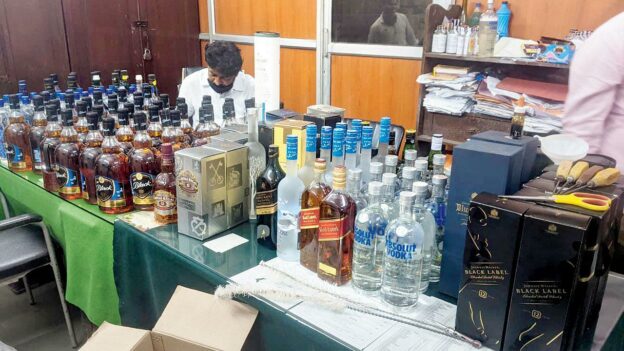
A series of high-profile raids across western and northern India has once again thrown the spotlight on the thriving and increasingly sophisticated network of interstate liquor smuggling, a trade fuelled as much by prohibition laws as by India’s fragmented excise regime.
In Ahmedabad’s Narol area, police recently intercepted a truck carrying what appeared to be a legitimate consignment of helmets. Acting on specific intelligence, the city’s Prevention of Crime Branch (PCB) kept watch near Sainath Parking on the S.P. Ring Road and stopped the vehicle late night. Beneath 1,053 helmets stacked in the upper section of the truck, officers found 10,749 bottles of foreign liquor, allegedly being transported in violation of Gujarat’s prohibition law.
The liquor haul was valued at ₹63.86 lakh, while the helmets were worth ₹5.25 lakh. The Himachal Pradesh-registered truck, along with a mobile phone and cash, was seized, taking the total value of confiscated property to over ₹84.22 lakh. The driver, identified as 38-year-old Johnny Baldevsinh Chandel from Mandi district in Himachal Pradesh, was arrested. Preliminary investigations indicated that the consignment had been loaded in Chandigarh and was destined for Junagadh.
Under the Cover of Legitimate Goods
Police officials noted that smugglers increasingly use legitimate goods, from helmets to medicine cartons, as cover to evade routine highway checks. In October 2025, the Sola High Court Police Surveillance Squad intercepted another truck near Gota Bridge in Ahmedabad carrying boxes labelled as hospital medicine that concealed 5,520 bottles and tins of Indian Made Foreign Liquor (IMFL) worth about ₹30.9 lakh. Two men from Punjab were arrested in that case.
Similar seizures have followed a pattern. In September 2025, Vadodara’s Special Monitoring Cell seized 8,231 bottles of IMFL valued at ₹44.93 lakh from a pickup truck near Kapurai crossroads. The vehicle was confiscated and police launched a hunt for the broader network.
Even social gatherings have come under scrutiny. In a dramatic raid near Ahmedabad, police arrested 43 men and detained 38 women during a marriage anniversary celebration where liquor was allegedly being served illegally. Authorities seized alcohol bottles, hookahs, cars and mobile phones collectively valued at ₹2.3 crore. Gujarat, a “dry” state where the manufacture, sale and consumption of liquor are prohibited (except in GIFT City), continues to witness periodic crackdowns under the Gujarat Prohibition Act.
Nasha Mukt Bharat Abhiyan
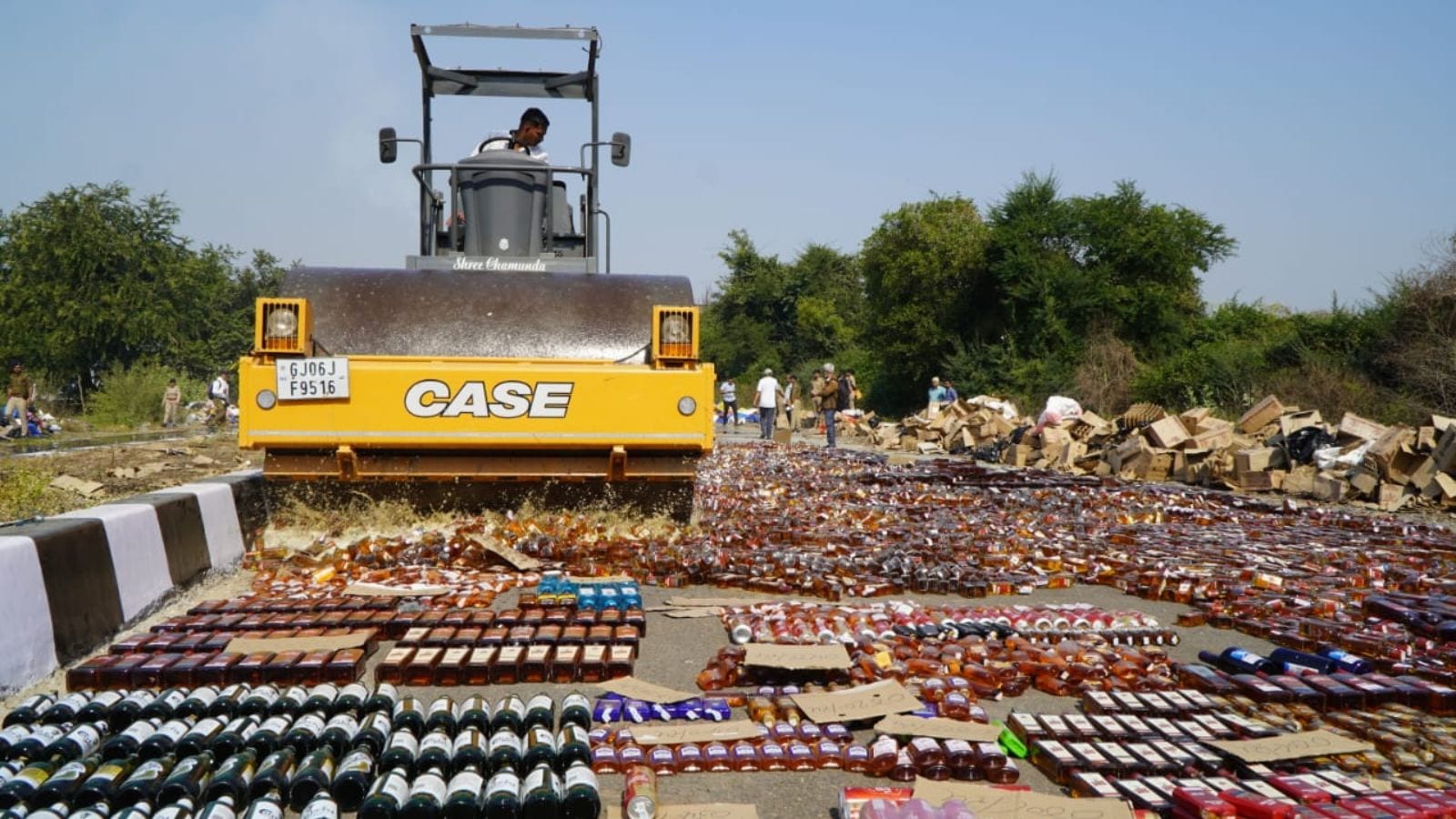
Elsewhere, enforcement agencies are also attempting to stem illicit supply. In Haryana’s Panchkula, police destroyed 416 cases of illegal liquor worth ₹21 lakh as part of the Nasha Mukt Bharat Abhiyan. The haul included English liquor, country-made liquor, beer bottles and thousands of quarters seized between 2022 and 2025.
In Maharashtra, the State Excise Department recently undertook what officials described as one of its most decisive actions in recent years. Kagal Excise Inspector Shankar Amberkar travelled to Goa to probe the manufacture of spurious liquor bearing fake Maharashtra labels. Two companies involved in producing labels, bottle caps and packaging material were sealed with the permission of the State Excise Commissioner. A conveyor belt used for manufacturing counterfeit bottle caps, along with caps, labels and boxes, was seized. Officials indicated that the illicit trade could have cost the Maharashtra government crores of rupees in lost revenue.
These cases, spanning Gujarat, Haryana, Maharashtra and Goa, illustrate not isolated criminal enterprises but an entrenched interstate supply chain shaped by policy asymmetries.
Prohibition and the Demand-Supply Gap
Gujarat remains the most prominent example of how prohibition can create a lucrative underground market. With a legal ban on the manufacture, sale and consumption of alcohol, except under tightly controlled permit systems, demand does not disappear. Instead, it migrates into informal and illegal channels.
Bootleggers exploit porous borders with Rajasthan, Madhya Pradesh, Maharashtra and the Union Territory of Daman and Diu, where liquor is legally available. Trucks carrying legitimate goods provide cover for concealed consignments. Smaller vehicles, private cars and even courier services are sometimes used to transport limited quantities.
The economics are straightforward, scarcity combined with legal risk inflates prices. A bottle that retails legally for ₹1,000 in a neighbouring state can command significantly higher rates within a dry state. The risk premium, covering transport, bribes, losses from seizures and operational costs, is built into the final selling price.
Law enforcement agencies have repeatedly acknowledged that intelligence-led operations are required to intercept such consignments, but the sheer volume of road traffic and the length of state borders make complete enforcement nearly impossible.
The Excise Puzzle
Beyond outright prohibition, India’s federal structure creates a patchwork of excise duties that vary widely from state to state. Alcohol taxation falls within the jurisdiction of state governments, making it one of their most significant revenue streams. Excise collections often account for 15–25% of a state’s own tax revenue.
Each state sets its own excise duty, additional excise duty, special fees, licence charges and distribution margins. The result is significant price variation across state lines.
For example, a premium IMFL brand may retail at sharply different price points in Delhi, Haryana, Rajasthan and Maharashtra due to variations in excise duty, value-added tax (VAT), and distributor margins. Lower-tax states frequently become source points for illegal diversion into higher-tax markets.
Border districts become particularly vulnerable. Liquor legally purchased in a low-tax state can be transported in bulk and sold informally in a neighbouring high-tax state at a price lower than the official retail price there, while still generating substantial profit for smugglers.
In some cases, counterfeit labelling adds another layer. As seen in the Maharashtra-Goa case, spurious labels are used to pass off liquor as locally taxed stock, allowing illegal entry while evading higher excise duties.
Revenue Pressures and Enforcement
On one hand, high excise duties generate substantial revenue. On the other, steep taxation creates incentives for tax evasion and smuggling.
Maharashtra’s excise department, which has a revenue target of ₹40,000 crore for the current financial year, views illicit liquor not merely as a law-and-order issue but as a fiscal threat. Officials involved in the Goa operation indicated that fake-labelled liquor entering the state could have resulted in revenue losses running into crores.
Similarly, Gujarat’s periodic large-scale seizures underscore the enforcement cost of maintaining prohibition in a geographically connected marketplace.
Experts argue that as long as sharp interstate price differentials exist, arbitrage opportunities will persist. Prohibition intensifies this dynamic by converting entire states into high-risk, high-margin destinations.
Technology, including track-and-trace systems, holograms, QR-coded excise labels and coordinated interstate intelligence sharing, has improved oversight. Yet, smugglers adapt quickly, using sophisticated concealment methods such as embedding bottles within legitimate cargo.
The recent raids suggest that enforcement agencies remain vigilant. However, they also highlight the structural drivers of the illicit trade: policy divergence, fiscal dependence on alcohol revenues, and persistent consumer demand.
Until excise frameworks are harmonised or border enforcement becomes near-airtight both unlikely in the near term, interstate liquor smuggling is poised to remain a recurring headline, surfacing in helmet consignments, medicine cartons, wedding banquets and beyond.