
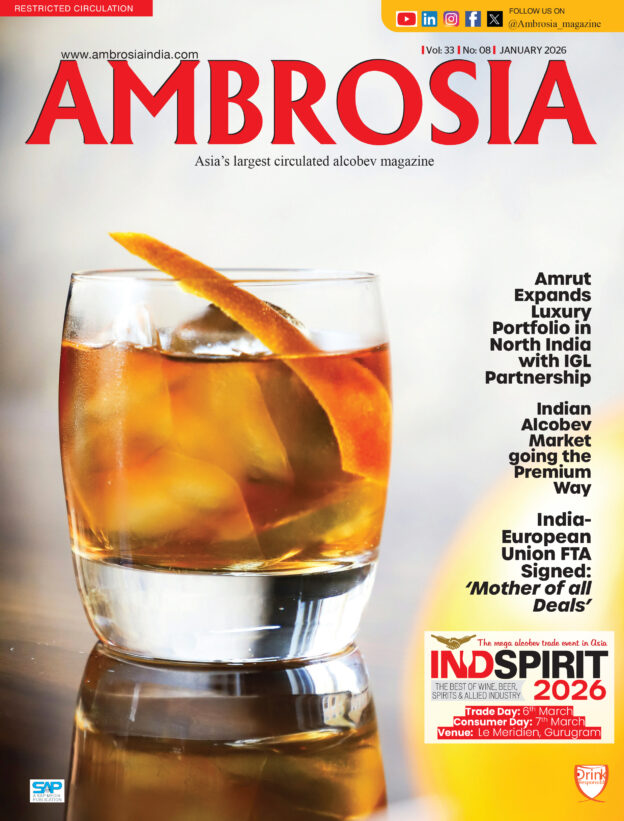
The January 2026 issue of Ambrosia Magazine is live! (Click Here)
It features engaging and insightful articles such as:
• India-European Union FTA Signed: Mother of All Deals
• Indian Alcobev Market going the Premium way
• @amrutmalt.global Expands Luxury Portfolio in North India with IGL Partnership
• Why India Matters to HiteJinro (@hitejinrobeverage) Now and How Monika Alcobev fits into Jinro (@jinro_global) Soju’s plan jinro
• @airindia unveils a refreshed beverage colection featuring celebrated wines and spirits from across the world
• Johnnie Walker Blonde Lemonade (@johnniewalkerindia) sponsors Lollapalooza India (@lollaindia) 2026
• Maharashtra signs ₹500-crore Investment MoU with @carlsbergindia at Davos
• Exclusive interviews with Heemanshu Ashar, Global Ambassador for Paul John Single Malt, Karishma Manga Bedi, Founder & CEO of Those Good Distillers and more.
Read 1 year of the e-magazine for FREE — register on www.ambrosiaindia.com
India-EU FTA Signed:
Has the Game Officially Changed?
With the ink now dry on the India-EU Free Trade Agreement, the alcobev industry has crossed a threshold it has waited decades for. This is no longer a policy discussion or a negotiation headline-it is a structural reset for how India
trades, consumes and thinks about wine and spirits. At the centre of the agreement lies a long-standing friction point: import duties.
While the FTA does not open the floodgates overnight, it formally commits both sides to phased and predictable tariff reductions on wines and spirits from the European Union. That clarity alone is transformative. For the first time, global producers, Indian importers, and domestic players can plan with certainty rather than hope. While the detailed provisions of the agreement are awaited, the initially released agreement indicates that the proposed reduction in import tariffs from the current 150% to 75% across all EU spirits & wines categories from the entry into force of the agreement, is a clearly welcome development. The agreement further outlines that the tariffs will then be lowered to 40% for spirits and as low as 20% on wines in a phased approach.
For European alcobev companies, India has officially moved from ‘high-potential but high-risk’ to strategic priority market. Reduced duties allow portfolios—not just prestige labels—to enter India meaningfully. Expect greater depth across categories: accessible Scotch and Irish whiskies, wider Cognac ranges, Champagne beyond celebration moments, and European wines that finally sit at dinner tables rather than behind glass cabinets.
Indian producers, understandably, will feel the heat. But this deal is not a death knell for domestic brands—it is a reality check. Protectionism has limits, and Indian distillers have already shown they can compete on quality, narrative, and innovation. The FTA will accelerate a necessary shift: from surviving behind barriers to winning on merit.
Wine may be the biggest long-term beneficiary. With duties easing, imported wines are likely to enter more realistic price brackets, fuelling everyday consumption and education. However, this could also possibly mean curtains for many Indian Wine producers. And that matters because wine builds culture before it builds volume—and India needs both.
Of course, the agreement does not erase India’s internal complexities. State taxes, distribution bottlenecks, and regulatory fragmentation remain. But the FTA wasn’t designed to solve everything. It was designed to set direction. And the direction is clear. India has chosen integration over insulation. Europe has chosen engagement over hesitation. For the alcobev industry, this isn’t just a trade deal—it’s the moment the market officially grew up.